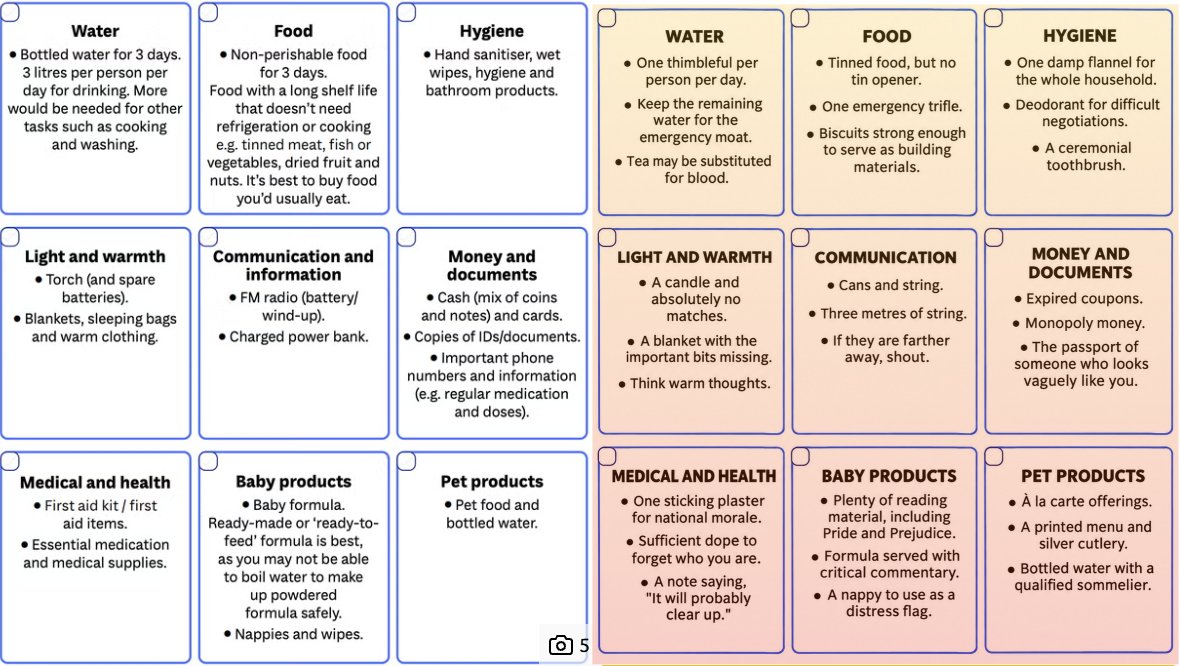
I could barely contain erupting laughter when I read an Independent article (https://www.independent.co.uk/news/uk/home-news...) outlining the British governments civil defence measures that are the response to supposed cyberattacks on various establishments, most notable the destruction of food when refrigeration failed (https://www.theguardian.com/technology/2026/nov...).
In a way that is entirely consistent with the British lack of awareness of how ridiculous they are, the government issued a sober advisory, complete with a convenient ‘cheatsheet’ (see image - left). Of course, this begged to be lampooned (see image - right).
Though some may not see the humour in rotten meat and melted ice-cream, surely they realise that this advisory is perhaps the best illustration this year of misdirection (“Look over here” while they slip the coin behind your ear).
Naturally, that boogey man ‘Cyberattack’ is to blame and almost certainly originating in North Korea. We should all prepare for the Battle of Britain again and stiffen our now lax upper lips.
"Shoppers began responding to the ‘Be Ready’ public awareness campaign from 22 October, with sales of tinned food, wind-up radios and torches all spiking since the updated government guidance was announced.
It comes as figures from Worldpanel by Numerator show supermarket prices are now 2.6 per cent higher than a year ago, an increase from 2.5 per cent in September.
Hand sanitiser sales climbed 83 per cent in the 10 days after the campaign’s launch compared with the same period last year, while bottled water sales rose 67 per cent over the same window, and tinned and jarred goods were up 37 per cent.
Shoppers began responding to the ‘Be Ready’ public awareness campaign from 22 October. The number of people buying tinned meat each day after the launch rose by 43 per cent, equivalent to an extra 400,000 shoppers a day."
There can only be one rational response to the emerging situation. Ask the question, “In what universe does a fridge become vulnerable to cyberattack?” Why is the fridge even connected to the cloud? And if it was the power system, why does the supermarket have no backup power?
In China, the fool who made the decision to make the fridges ‘smart’ would be jailed for reckless disregard for public welfare and security. In the UK, this idiot probably got a raise. Why does a fridge in a supermarket require remote monitoring and control?
Too late, the world is waking up to the realisation that cloud-based control systems and data storage makes cyberattacks not just inevitable but certain. If you are a hacker, where else would you look? Most on-premises systems are locked up like Fort Knox, to coin a cliché. The poorly managed and foreign owned cloud systems are just too good a target to be passed by.
As a UK comedian says, “We are addicted to systems where there is no friction – everything is easy and ‘free’ and we are surprised when they fail.“ And rather than designing secure systems which don’t expose your critical infrastructure and data to the wanton whims of a pimply incel in his basement, it is ‘de rigueur’ to implement ‘efficient’ systems, the management of which can be outsourced to a ‘start-up’.
I grow daily wearier of the willingness of our Western states to hand over management of our most important institutions to ‘cowboys’ (with less moral fibre than their namesakes). Then, when the inevitable ‘unforeseen’ consequences result in crisis, they implore us to ‘be ready’. It’s no joke. It’s failure. It’s reckless disregard by the state for the welfare of its citizens.
But I am heartened by the collapse of the tech sector (Nvidia’s and Google’s stock value in free fall) as corporations world-wide recognise that their ‘old-fashioned’ instinct to have systems managed ‘on-premises’ is where they must return.
Comments
Leave a Comment
Sign in to have your comments approved automatically.
No comments yet. Be the first to comment!